
If your dryer has been acting strange — taking two cycles to dry one load, making your laundry room uncomfortably hot, or giving off a faint burning smell — don’t ignore it.
These are classic signs of a clogged dryer vent. And in Northern Virginia, where humidity is high and many homes have long or complex vent runs, a blocked dryer vent is more common than most homeowners realize.
More importantly: it’s a fire hazard. The NFPA reports that dryers cause an average of nearly 16,000 home structure fires every year in the United States — and failure to clean is the leading cause. This isn’t a maintenance task you can put off.
At ABD Air Duct & Vent Cleaning, we’ve cleared thousands of dryer vents across Fairfax, Chantilly, Centreville, Burke, Arlington, Alexandria, and the greater Northern Virginia area. Here are the 8 most common signs your dryer vent is clogged, what each one means, and exactly what you should do about it.
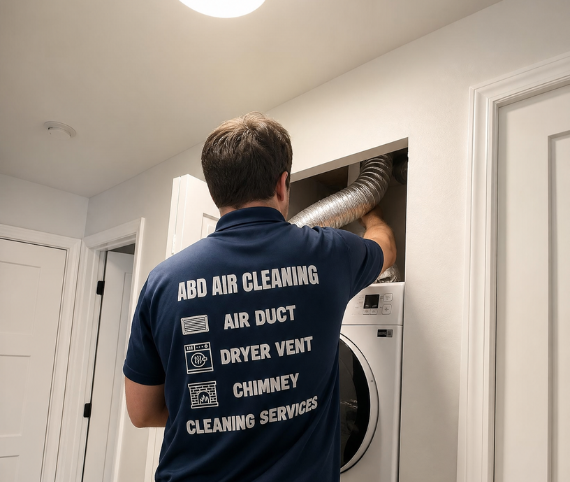
A burning smell while your dryer is running is not a “wait and see” situation. It means lint inside your vent is overheating and may be on the verge of igniting. Turn off your dryer immediately and do not run it again until the vent has been professionally inspected and cleared.
 Call ABD right now: (571) 581-9131
We serve all of Northern Virginia and offer same-day appointments in many cases.
Before we get into the signs, it’s worth understanding why this matters so much.
Your dryer works by pulling air in, heating it, tumbling your clothes through it, and pushing that hot, moisture-laden air out through a vent that exits your home. That process also pulls lint — tiny fibers off your clothes — and over time, that lint coats the inside walls of your vent duct.
Here’s the problem: lint is highly flammable. When enough builds up to restrict airflow, heat can no longer escape properly. The dryer works harder, temperatures climb inside the vent, and eventually that lint can ignite.
According to the NFPA, between 2014 and 2018, U.S. fire departments responded to an average of 14,630 home structure fires annually involving clothes dryers — leading to an average of 13 civilian deaths, 444 injuries, and $238 million in property damage every year. The leading factor in those fires: failure to clean.
This isn’t fearmongering. It’s why we take dryer vent cleaning as seriously as we do.
This is the most common and obvious sign — and the one most homeowners notice first.
If a load that used to dry in 45 minutes now takes an hour, or you’re routinely running two cycles just to get towels or jeans fully dry, your vent is almost certainly restricted. When airflow is blocked, the hot moist air your dryer is trying to expel has nowhere to go — it just recirculates, and your clothes stay damp no matter how long the cycle runs.
Cleaning technicians regularly find that clearing a clogged vent reduces drying times significantly — often back to a single cycle. What you’ve been paying in electricity for double cycles adds up fast.
What to do: Don’t keep running extra cycles. Book a dryer vent cleaning. The longer you run a clogged dryer, the more lint compresses and the hotter the system gets.
A dryer should feel warm — not hot enough to be uncomfortable to touch. If the top or sides of your dryer are very hot to the touch after a cycle, or if your laundry room feels noticeably warmer and more humid than the rest of the house, that heat has nowhere to go.
When the vent is clear, hot air flows out efficiently. When it’s blocked, that heat backs up into your dryer, into your laundry room, and potentially into the wall cavity where your vent runs. That last part — heat building up inside a wall — is how a dryer fire can spread quickly and silently.
What to do: Stop running the dryer until the vent is inspected. A hot dryer is a stressed dryer, and a stressed dryer in a clogged vent system is a genuine fire risk.
A burning smell during or after a dryer cycle is an urgent warning sign. It almost always means lint inside the vent is overheating — and lint ignites easily.
This smell is sometimes described as a hot, dusty, or slightly acrid odor. It’s different from the normal “warm laundry” smell. If you notice it, trust your instincts.
What to do: Turn the dryer off immediately. Don’t run another cycle. Call ABD at (571) 581-9131 — we offer same-day service across Northern Virginia.
Walk outside your home while the dryer is running and find where the dryer vent exits the building. There should be a vent hood with a flap that opens when air is flowing through it. Hold your hand near it — you should feel a strong, warm, consistent stream of air.
If the flap barely moves, opens weakly, or you feel little to no airflow, the vent is significantly restricted. You may also find lint accumulated around the exterior vent opening itself — another clear sign of blockage.
In Northern Virginia, exterior vents are also a common entry point for birds and small animals looking to nest in fall and winter. We’ve removed live bird nests, wasp nests, and mouse debris from dryer vents across Fairfax County. Any of these will block airflow completely.
What to do: Don’t attempt to clear a nest yourself — especially if it’s an active bird nest (in Virginia, many migratory birds are federally protected during nesting season). Call a professional to clear the obstruction safely and inspect for damage.
You should see lint in your lint trap — that’s normal. But if you’re noticing lint accumulating around the opening of the vent hose at the back of your dryer, on the floor behind the dryer, or building up around the exterior vent opening outside your home, that lint has nowhere else to go because the duct is backed up.
This visible overflow is a sign that the internal buildup is substantial — enough that lint is pushing backward out of the system rather than exhausting properly.
What to do: Schedule a professional cleaning. At this stage, the buildup inside the duct is likely significant enough that DIY tools won’t fully clear it.
Modern dryers have a thermal safety switch — a fail-safe that automatically shuts the machine off if internal temperatures get dangerously high. If your dryer keeps stopping before the cycle is complete, that thermal switch may be tripping to prevent a fire.
This is the dryer’s last line of defense. A dryer that shuts itself off mid-cycle is telling you something is wrong with airflow. Do not keep restarting it and hoping it finishes.
What to do: This one needs immediate professional attention. The thermal switch tripping repeatedly can also damage the switch itself, which can lead to costly dryer repair — or worse, a switch that fails to trip when it should.
This one isn’t a symptom — it’s a timeline warning. Most dryer vent cleaning professionals recommend annual cleaning for average households. If you use your dryer frequently (large family, pets, frequent bedding washes), you may need it done more often.
If you can’t remember the last time your dryer vent was cleaned — or you’ve never had it done — you likely have significant buildup regardless of whether you’ve noticed symptoms yet. Clogs develop gradually. By the time you notice the signs, the vent has usually been restricted for months.
What to do: Don’t wait for symptoms. Schedule a cleaning as routine annual maintenance, the same way you’d schedule an HVAC tune-up or a chimney inspection.
If your laundry comes out of the dryer hot to the touch — not just warm, but hot enough that you’d rather let it cool before folding — that’s a sign that heat isn’t venting properly. The heat that should be exiting through the vent is staying in the drum with your clothes.
Overheated clothes also wear out faster. The heat breaks down fabric fibers and elastic, which is why you might notice clothes shrinking or fabrics feeling rough after repeated drying cycles. A clogged vent doesn’t just create a fire risk — it’s quietly damaging your wardrobe every cycle.
What to do: Schedule a vent cleaning and run a test load afterward. You’ll notice the difference in both temperature and drying time immediately.
Northern Virginia homeowners face a few conditions that make dryer vent maintenance especially important:
Long vent runs in townhomes and condos. Many townhomes in Reston, Herndon, Chantilly, and Alexandria have dryers located in interior rooms — far from an exterior wall. That means longer vent ducts with more bends and turns, which collect lint faster and are harder to clear without professional equipment.
High humidity. The hot, humid summers in Northern Virginia mean that even when your dryer is running, the air outside isn’t pulling moisture out as efficiently as it would in a drier climate. Moisture can linger inside the vent longer, causing lint to clump and compact rather than blow through cleanly.
Wildlife. Northern Virginia’s tree canopy means birds, squirrels, and wasps are actively looking for warm, enclosed spaces — especially in fall and early winter. Exterior dryer vents are a frequent target. We find nesting material inside dryer vents year-round in Fairfax County.
Flexible plastic or foil accordion ducts. Many older homes in Annandale, Burke, Springfield, and Falls Church still have flexible accordion-style dryer vent hoses rather than rigid metal duct. These accordion hoses trap lint in every fold and are no longer up to code in many jurisdictions. If your dryer has one, it should be replaced with rigid metal duct — and in the meantime, it needs cleaning more frequently.
You can — to a point. If your vent run is short and straight (typically less than 5–6 feet), a dryer vent cleaning brush kit from a hardware store can help. Here’s when DIY is and isn’t appropriate:
DIY may be okay if:
Call a professional when:
Professional equipment — including rotary brush systems and high-powered vacuums — can clear full-length vent runs that DIY brushes simply can’t reach. At ABD, we also inspect the vent exterior hood and check for damage, disconnections, or animal entry points as part of every cleaning.
Here’s exactly what you can expect when you book a dryer vent cleaning with ABD:
The whole process typically takes 30–60 minutes for a standard dryer vent. Longer runs or significant obstructions may take longer.
ABD’s dryer vent cleaning starts at $149 for a standard vent run. Longer runs, roof vents, or vents with animal obstructions may be priced higher — we’ll always confirm the price before any work begins.
We frequently bundle dryer vent cleaning with air duct cleaning at a discount when both are scheduled on the same visit. Ask about bundle pricing when you call.
If you’ve recognized any of the signs in this post, your dryer vent needs attention. The longer a clog goes unaddressed, the more lint compacts, the hotter your system runs, and the higher your fire risk climbs.
ABD Air Duct & Vent Cleaning is QUADCA-certified, based right here in Fairfax, VA, and has 290 verified 5-star Google reviews. We serve homeowners throughout Northern Virginia — from Great Falls to Woodbridge, from Chantilly to Alexandria.
Call us now: (571) 581-9131  Email: info@abdaircleaning.com
  Book online here
We offer same-day appointments in many cases. Don’t run another load until your vent has been inspected.
What are the most common signs of a clogged dryer vent? The most common signs are clothes taking longer than usual to dry (two or more cycles for one load), the dryer or laundry room feeling excessively hot, a burning smell during operation, and weak or no airflow from the exterior vent. Any of these warrants a professional inspection immediately.
Is a clogged dryer vent dangerous? Yes — seriously dangerous. The NFPA reports that home dryer fires cause an average of 13 deaths, 444 injuries, and $238 million in property damage every year in the U.S. The leading cause is failure to clean the dryer vent. A clogged vent allows lint to overheat and ignite.
How often should a dryer vent be cleaned in Northern Virginia? Most households should have dryer vents cleaned annually. Homes with large families, heavy dryer use, pets, or long vent runs (common in Northern Virginia townhomes and condos) may need cleaning every 6–9 months.
Can I clean my dryer vent myself? For very short, straight vent runs, a DIY brush kit can help with basic maintenance. For any vent run over 5–6 feet, multi-bend runs, long duct routes (common in NoVA townhomes), or vents with animal obstructions, professional equipment is required to fully clear the duct.
Why does my dryer smell like burning? A burning smell during a dryer cycle usually means lint inside the vent is overheating and could be close to igniting. Turn the dryer off immediately and do not run it again until a professional has inspected and cleared the vent.
How much does dryer vent cleaning cost in Fairfax, VA? ABD’s dryer vent cleaning starts at $149 for a standard vent run. Longer runs or vents with animal obstructions may be higher — we confirm pricing upfront before starting any work. Bundle discounts are available when combined with air duct cleaning.
Does ABD serve my area in Northern Virginia? ABD serves Fairfax, Chantilly, Centreville, Burke, Springfield, Annandale, Alexandria, Arlington, Reston, Herndon, Vienna, McLean, Great Falls, Oakton, Falls Church, Woodbridge, Manassas, South Riding, Lorton, Tysons, and the broader DMV area.
(571) 581-9131
info@abdaircleaning.com
Mo-Sun 8AM-8PM
Satisfaction
Located in Fairfax, ABD Air Duct and Vent Cleaning offers top-quality dryer vent, chimney air duct cleaning services to ensure a healthier and cleaner indoor environment.