
If you live in a townhome in Northern Virginia, your dryer vent is almost certainly more complicated — and more dangerous — than you think.
Most homeowners assume a dryer vent is a short, simple duct that runs straight out through a wall. In a single-family home, that’s often true. In a townhome — the dominant housing type across Fairfax, Chantilly, Centreville, Reston, Herndon, Burke, Springfield, and South Riding — the dryer vent is a completely different animal.
Townhome dryer vents are longer. They have more bends. They often travel through multiple floors before exiting through a roof. They accumulate lint faster, clog more dangerously, and require professional equipment that most homeowners — and even some cleaning companies — simply don’t have.
At ABD Air Duct & Vent Cleaning, we’re a QUADCA-certified company based in Fairfax, VA. We’ve cleaned thousands of dryer vents in townhomes throughout Northern Virginia. In this guide we’ll explain exactly why townhome vents are different, what proper cleaning involves, why DIY doesn’t work for most townhome vent configurations, and how to know when yours needs attention.
In a townhome with a long or complex vent run, an extended drying cycle is not just an inconvenience. It means your vent is significantly restricted and your dryer is running dangerously hot. Do not keep running extra cycles.
 Call ABD immediately: (571) 581-9131 Same-day appointments available across Northern Virginia.
This is the most important thing to understand — and something most generic dryer vent cleaning guides completely ignore.
In a typical single-family home in Fairfax County, the laundry room is often on the main floor or in a finished basement near an exterior wall. The dryer vent runs a short, relatively direct path — often 6 to 10 feet — to an exit point on the side of the house.
In a Northern Virginia townhome, the story is very different. Laundry rooms in townhomes are almost always located in an interior space — frequently on the second or third floor, in a hallway closet, or in a room with no direct access to an exterior wall. That means the dryer vent has to travel a long, winding path through walls and floors before it can exit the building.
The result: townhome dryer vent runs in Northern Virginia commonly range from 15 to 35 feet in length. Many have 4, 5, or even 6 bends and turns. Some exit through the roof rather than a side wall. Each additional foot of duct and each additional bend creates more surface area for lint to accumulate — and more resistance that your dryer has to work against every single cycle.
This surprises many townhome owners. Because exterior side-wall exits aren’t always possible in attached townhomes — where you share walls with neighbors — builders frequently route the dryer vent up through the interior of the home and out through the roof.
Roof exit dryer vents create several specific challenges:
They are much harder to inspect. You cannot see or easily access a roof vent cap from inside your home. Lint accumulates at the cap, birds and wasps nest inside the hood, and debris collects at the exit point — all without any visible sign from inside.
Lint compacts more severely. The longer the vertical run and the more bends a vent has, the more lint compacts under its own weight rather than blowing through cleanly. What would be a loose clog in a short vent becomes a dense, compacted mass in a long multi-floor run.
Professional ladder and roof access is required. Properly inspecting and clearing a roof exit vent requires ladder access to the roof — something most DIY brush kits aren’t designed for and most homeowners aren’t equipped to do safely.
In a single-family home, portions of the dryer vent often run through an unfinished basement or crawl space where cleanout access points can be installed and accessed. In a townhome, virtually the entire vent run passes through finished drywall — walls and ceilings that have been painted and decorated. There is no easy access point, which means professional rotary brush equipment that can navigate the full run from inside is the only practical cleaning method.
The communities surrounding Fairfax, Chantilly, Centreville, Reston, Herndon, Burke, and South Riding include some of the highest concentrations of townhome housing in the entire Mid-Atlantic region. Communities like:
…are almost entirely townhome communities. Every one of these homes has a dryer vent system more complex than a standard single-family home — and most haven’t been professionally cleaned in years.
It’s not just that townhome vents are longer and more complex — they also accumulate lint at a significantly faster rate than single-family home vents. Here’s why:
The Virginia Mechanical Code allows for a maximum equivalent duct length for dryer exhaust systems, with each 90-degree bend counting as an equivalent of several additional feet of straight duct. A townhome vent with five 90-degree bends may have an effective resistance equivalent to 40+ feet of straight duct even if the physical run is only 25 feet.
Each bend in the duct creates a surface where lint slows, catches, and builds up. In a vent with five bends, you have five natural accumulation points — and lint at each one compacts the flow, causing more lint to accumulate upstream. Over time, a townhome vent can become completely blocked at a bend in the middle of a wall with no external sign other than reduced dryer performance.
Hot, moist air from your dryer needs to travel the full length of the vent run to exit. The longer the run, the more that air cools as it travels. As air cools inside the duct, moisture condenses on the duct walls — and damp duct walls cause lint to stick rather than flow through. In a short vent run, lint blows through cleanly. In a long townhome run, it sticks, builds up, and eventually becomes a dense blockage.
Northern Virginia’s humid summers compound this significantly. The temperature differential between the hot air coming out of your dryer and the warm, humid conditions in your duct walls during summer is smaller than in drier climates — meaning less of the moisture carries through and more of it stays inside the duct.
Many Northern Virginia townhome communities were built between the late 1980s and early 2000s when flexible plastic or foil accordion duct was the standard material for dryer vent runs. This accordion duct — now recognized as a fire hazard and prohibited by current building codes — has deep ridges and folds that trap lint at every surface. A short run in smooth metal duct might be cleaned every two years without major buildup. The same-length run in accordion duct can become dangerously restricted within months.
If your townhome was built before 2000 and the dryer vent has never been upgraded, you almost certainly have at least a portion of accordion duct in the run. This is a code violation that creates both a fire risk and an accelerated clogging problem.
For a standard single-family home with a short, direct vent run, annual cleaning is the general recommendation from the NFPA and NADCA. Townhomes are different.
For most Northern Virginia townhomes, we recommend cleaning every 6 to 9 months.
Here’s why the frequency is shorter:
The following townhome situations warrant cleaning every 6 months specifically:
| Situation | Why it accelerates buildup |
|---|---|
| Vent run over 20 feet | Lint has more distance to accumulate |
| Roof exit vent | Debris, moisture, and wildlife constantly challenge the cap |
| 4+ bends in the run | Multiple compaction points fill faster |
| Pre-2000 accordion duct | Ridged surface traps lint continuously |
| Large family (5+ people) | Higher laundry volume = more lint per week |
| Pets (especially heavy shedders) | Pet hair bypasses lint traps and compacts in duct bends |
If you are not sure about your vent configuration, a professional inspection will tell you exactly what you have and how frequently your specific system needs service.
This is critical to understand — and something many townhome owners find out the hard way.
The brush kits sold at hardware stores — typically a flexible rod with a round brush attachment — are designed for short, straight vent runs. They extend 10 to 15 feet and work reasonably well for the simple, direct vents found in many single-family homes.
They do not work for townhome dryer vents. Here’s why:
They can’t reach the full length of a townhome run. A 25-foot vent run requires equipment that can navigate 25 feet through multiple bends. Consumer brush kits top out at 12 to 15 feet and cannot navigate around 90-degree bends without losing purchase and getting stuck.
They can compact lint deeper into the duct. This is a serious risk. Pushing a brush into a vent that has a compacted clog further down can compress the clog, making it denser and harder to remove — while giving the impression that the vent is clear because the brush traveled partway. In a long townhome run, you may clear the first 10 feet while driving more lint into the middle of the run where your brush can’t reach.
They can’t access roof exit points. Clearing a roof vent cap — particularly one with bird nesting material or compacted lint at the exit — requires ladder access and professional tools. A brush inserted from inside your home cannot fully clear a clogged roof cap.
They can damage accordion duct. The ridged surfaces of flexible accordion duct can catch on a stiff brush and tear or disconnect sections of the duct — creating gaps that vent into your wall cavity rather than outside. This is both a fire hazard and a moisture problem.
There is no vacuum capture. Professional dryer vent cleaning uses high-powered vacuum capture at the exit point simultaneously with the rotary brush cleaning. This captures all lint as it’s dislodged, preventing it from being blown back into your dryer or laundry room. DIY brush kits have no vacuum capture — loose lint goes somewhere, but often not where you want it.
We’ve cleaned hundreds of townhome dryer vents across Northern Virginia and we’ve developed a specific approach for the complex configurations found in these homes:
Before we start, we assess your full vent configuration — the connection at the dryer, the path through your walls and floors, the exit point (roof or wall), and the condition of the duct material. We document with photos and explain what we find before any work begins.
We use commercial-grade flexible rotary brush rods that navigate bends and travel the full length of any townhome vent run — including runs over 30 feet with multiple bends. Our high-powered vacuum captures lint continuously at the exit point while the brush works from the inside, so all dislodged lint is removed from your home rather than blown back into it.
When your vent exits through the roof, we bring ladders and roof-safe equipment to access the cap from the outside. We inspect the cap, remove any animal nesting material or debris, clear the exit point, and check the cap’s condition and fit. A damaged or improperly seated roof cap is a major contributor to recurring blockages and wildlife entry.
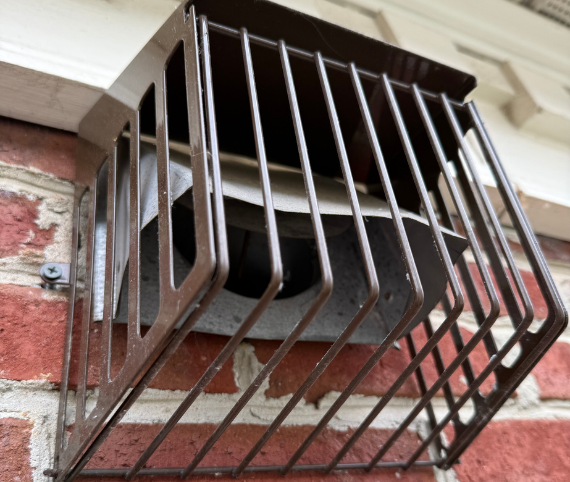
Northern Virginia’s wooded townhome communities are prime territory for birds and wasps looking for nesting sites — and roof dryer vent caps are a favorite target. We install durable bird guard covers after every cleaning that allow full airflow while blocking access for birds, wasps, and rodents. This is a standard part of our townhome service in Chantilly, Reston, Herndon, and South Riding where nesting is particularly common.
If we find unsafe flexible accordion duct during our inspection, we document it, explain the fire risk and code issue, and provide a quote for replacement with smooth rigid metal duct. We never pressure you into an on-the-spot decision, but we always make sure you know what’s in your system.
We test airflow at the exterior exit point before and after cleaning so you can see the measurable difference. A before/after airflow comparison is something most companies skip — we include it on every townhome job.
Don’t wait for your scheduled maintenance window if you’re experiencing any of these. In a townhome with a long vent run, these symptoms indicate a significant blockage that only gets more dangerous with each cycle you run:
Your dryer takes more than one full cycle to dry a load. In a townhome, this is often the first sign — and it means the vent is already significantly restricted.
Your laundry room or hallway closet feels hot and humid after a cycle. Heat and moisture that can’t exit through the vent backs up into the space around your dryer. In a townhome with an interior laundry closet, this can be very noticeable.
You smell something musty or burning when the dryer runs. A musty smell means lint and moisture are sitting in your duct. A burning smell means lint is overheating. Either one warrants an immediate call.
The dryer shuts off before the cycle completes. The thermal safety switch is tripping because your dryer is reaching dangerous temperatures. Stop running the dryer and call us.
You haven’t had the vent cleaned in over a year. For most Northern Virginia townhomes, 12 months is already past the recommended window. If it’s been two or more years, cleaning is overdue regardless of symptoms.
You can’t remember if the vent was cleaned before you moved in. In the resale townhome market throughout Northern Virginia — particularly in older communities in Burke, Centreville, Springfield, and Herndon — it’s very common to buy a home with no record of when the dryer vent was last serviced.
Townhome cleaning is priced based on the length of your vent run, the number of bends, and whether roof access is required:
| Configuration | Estimated price range |
|---|---|
| Standard townhome vent (15–20 ft, wall exit) | $149 |
| Long run townhome (20–30 ft, wall exit) | $149 |
| Roof or attic exit townhome (any length) | $249 |
| Accordion duct replacement (per linear foot) | Quoted separately |
| Bird guard installation | $139 |
| Bundle with air duct cleaning (same visit) | Save $29 |
We provide a free estimate and confirm the exact price before starting any work. No surprises, no pressure, no on-the-spot upselling.
ABD Air Duct & Vent Cleaning is QUADCA-certified, locally based in Fairfax, VA, and has 290 verified 5-star Google reviews from Northern Virginia homeowners — many of them townhome residents in the communities we serve every week.
We know the vent configurations in Burke Centre, Sully Station, South Riding, Lake Anne, McNair Farms, Centre Ridge, Kingstowne, Springfield Station, and dozens of other Northern Virginia townhome communities. We bring the right equipment for every job — not just a brush kit and hope.
Call us: (571) 581-9131  Email: info@abdaircleaning.com
  Book online here
Same-day and next-day appointments available across Northern Virginia.
Why do townhome dryer vents clog faster than single-family homes? Townhome dryer vents are longer, have more bends, and often exit through the roof rather than a side wall. Longer runs with multiple bends create more surfaces for lint to accumulate and compact. Roof exit vents also collect wildlife nesting material and debris. The combination of length, complexity, and Northern Virginia’s humidity means townhome vents typically need cleaning every 6 to 9 months rather than the annual recommendation for simple single-family home vents.
Can I clean my townhome dryer vent myself? For most Northern Virginia townhomes, DIY cleaning is not effective and can be counterproductive. Consumer brush kits extend 10 to 15 feet and cannot navigate multiple 90-degree bends. Pushing a brush into a long vent with a compacted clog further down can compact the lint more, making it harder to remove. Roof exit vents require ladder access and professional tools. Professional rotary brush equipment with simultaneous vacuum capture is required for most townhome vent configurations.
How often should I clean my dryer vent in a Northern Virginia townhome? Every 6 to 9 months for most townhomes. Homes with runs over 20 feet, roof exits, multiple bends, pre-2000 accordion duct, large families, or heavy-shedding pets should clean every 6 months. Annual cleaning is the baseline for simple, short runs — which most Northern Virginia townhomes don’t have.
What if my dryer vent exits through the roof? Roof exit dryer vents are very common in Northern Virginia townhomes and require professional service. ABD brings ladders and roof-safe equipment on every job where roof access is required. We inspect the cap, clear any obstruction or nesting material, test airflow from the roof exit, and install a bird guard cover to prevent future wildlife access.
What is accordion duct and is it in my townhome? Accordion duct (also called flexible plastic or foil duct) was the standard material for dryer vent runs in townhomes built before approximately 2000. It is now recognized as a fire hazard and prohibited by current building codes. It has ridged surfaces that trap lint in every fold, clogs faster than smooth metal duct, and can overheat dangerously. If your townhome was built before 2000 and the dryer vent has never been upgraded, you may have accordion duct in your system. ABD identifies and documents this during every inspection.
How much does dryer vent cleaning cost for a townhome in Northern Virginia? ABD’s townhome dryer vent cleaning starts at $149 for wall-exit configurations and is $249 when the vent exits through the roof or attic. We provide a free estimate and confirm the exact price before starting. Bundle discounts apply when combined with air duct cleaning on the same visit.
Do you install bird guards on roof dryer vent caps? Yes — we install durable bird guard covers as part of every roof vent cleaning. Northern Virginia’s wooded townhome communities in Chantilly, Reston, Herndon, and South Riding have significant wildlife pressure, and roof dryer vent caps are a primary nesting target for birds and wasps. A properly installed bird guard allows full airflow while blocking entry.
Does ABD serve my townhome community in Northern Virginia? ABD serves townhome communities throughout Fairfax, Chantilly, Centreville, Burke, Springfield, Annandale, Reston, Herndon, Vienna, McLean, Alexandria, Arlington, Falls Church, Woodbridge, Manassas, South Riding, Lorton, Ashburn, and the entire Northern Virginia DMV area.
ABD Air Duct & Vent Cleaning is a QUADCA-certified dryer vent, air duct, and chimney cleaning company located at 11166 Fairfax Blvd, Suite 500, Fairfax, VA 22030. We specialize in townhome dryer vent cleaning throughout Northern Virginia. Call (571) 581-9131 or book online for a free estimate and same-day service.
(571) 581-9131
info@abdaircleaning.com
Mo-Sun 8AM-8PM
Satisfaction
Located in Fairfax, ABD Air Duct and Vent Cleaning offers top-quality dryer vent, chimney air duct cleaning services to ensure a healthier and cleaner indoor environment.