
It was a routine dryer vent cleaning call in Chantilly. The homeowner had called because her dryer was taking three full cycles to dry a load of towels — something that used to take one. She had cleaned the lint trap religiously. She had checked the back of the dryer. Everything looked normal from where she was standing. She had no idea what was wrong.
When our technician disconnected the transition hose and looked into the vent opening, he found out immediately. Packed inside the first two feet of the vent — so dense it had to be removed in sections — was a full bird nest. Twigs, dried grass, feathers, a few pieces of what appeared to be a shredded grocery bag, and two layers of compressed lint that had built up behind the nest over what looked like at least one full season. The exterior vent flap had been propped open by the nesting material long enough for a family of house sparrows to move in, raise young, and leave — and in their place they had left a fire hazard that the homeowner had been living with for months without knowing it.
This is not a rare story. We find bird nests inside dryer vents across Northern Virginia every spring — in Chantilly, Great Falls, McLean, Reston, Fairfax, Burke, and Vienna. Any wooded, tree-lined neighborhood where birds are active is a neighborhood where this can happen. And every single time, the homeowner had no idea until the dryer stopped working properly.
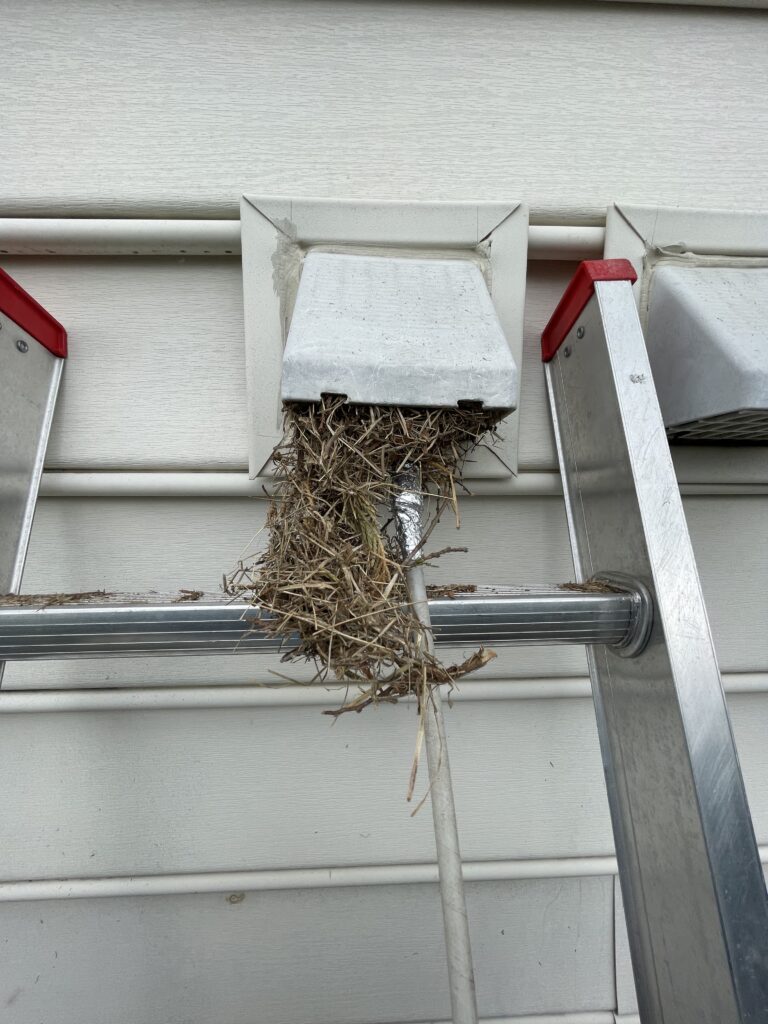
Birds — specifically house sparrows, European starlings, and wrens, the three most common culprits in Northern Virginia — look for two things when choosing a nesting site: warmth and shelter. Your dryer vent provides both in abundance.
Every time you run your dryer, warm air pushes through your vent and exits at the exterior cap. That cap is designed to open during dryer operation and close when the dryer is off. But over time, many exterior vent caps become stiff, loose, or damaged — and instead of closing fully when the dryer stops running, they stay slightly open. To a house sparrow scouting nesting locations in March and April, a slightly open dryer vent cap is an invitation. It is warm, sheltered from predators, protected from rain, and exactly the right size.
Northern Virginia’s established neighborhoods make this problem significantly worse than in newer developments. Communities like McLean, Great Falls, Vienna, Reston, Chantilly, and Burke have mature tree canopies that support large local bird populations. More birds in the neighborhood means more birds looking for nesting sites. More nesting site competition means birds are more motivated to use non-traditional locations — like your dryer vent — when natural options are taken.
The neighborhoods where we find bird nests most often in Northern Virginia: Chantilly — South Riding and Franklin Farm area wooded lots. Great Falls — wooded estate properties with longer vent runs. McLean — Langley and McLean Hills neighborhoods with mature trees. Reston — Reston Town Center adjacent communities and wooded townhome areas. Vienna — Vienna Woods and Westwood Hills with established canopy. Burke — Burke Centre and Kings Park West. Fairfax — established neighborhoods throughout Fairfax County. If you live in a tree-lined community anywhere in Northern Virginia and your dryer vent does not have a bird guard installed — read on. |
Most homeowners imagine a bird nest as a small, tidy structure sitting neatly inside a vent opening. The reality is messier, denser, and significantly more alarming.
A fully built bird nest inside a dryer vent is a compressed mass of nesting material — twigs, grass, feathers, plant fibers, bits of string or plastic, and whatever else the bird could carry — packed tightly into the vent cavity. Over weeks of use, lint from the dryer collects against the back of the nest and compresses further. The result is a dense, dry, highly flammable plug that restricts airflow from a trickle to nothing.
Here is the part that concerns our technicians most: nesting material is extraordinarily flammable. Dry twigs, feathers, and plant fibers ignite easily. Combined with the lint that has accumulated behind the nest and the heat that builds up when a dryer runs against restricted airflow — you have exactly the conditions that cause dryer vent fires. The National Fire Protection Association reports approximately 15,970 dryer fires per year nationally. Failure to clean the vent is the leading cause. Bird nests are one of the most dangerous specific versions of that failure.
Do not do this if you suspect a bird nest in your dryer vent: Do not attempt to remove a bird nest from your dryer vent yourself by pushing a brush through from the exterior. This compresses nesting material deeper into the vent rather than removing it, can damage vent walls, and leaves the underlying lint buildup completely untreated. If eggs or hatchlings are present, federal and state wildlife laws may also apply. Call a professional. ABD technicians remove bird nests and all associated debris from the full vent path and install a bird guard cover to prevent the problem from recurring. Call us at (571) 581-9131. |
You do not need to take your dryer apart or climb on your roof to check. These are the signs that something is blocking your dryer vent — and that something may be a bird nest:
Any one of these signs is enough to warrant a professional dryer vent inspection. If you are hearing sounds from the wall near your dryer in March, April, or May — the peak of bird nesting season in Northern Virginia — call us immediately. The earlier a nest is identified and removed, the lower the fire risk and the simpler the removal process.
A bird nest removal is not the same process as a standard dryer vent cleaning — and any company that tells you otherwise is not being straight with you. Here is exactly what our technicians do when a bird nest is discovered during a service call in Northern Virginia:
The bird guard installation is the step that separates a one-time fix from a permanent solution. A bird guard is a metal mesh cover that fits over your exterior dryer vent cap and allows hot air to flow out freely while physically preventing birds and small animals from entering. Without it, the same birds — or others from the same local population — will return to the same location next spring. We install bird guard covers after every service call in wooded Northern Virginia communities.
Everything we have described in this post — the blocked vent, the fire risk, the three-cycle drying times, the panicked spring phone call — is preventable with one simple step: a bird guard cover installed over your exterior dryer vent cap.
If your dryer vent currently exits through an exterior wall or roof without a bird guard, your vent is accessible to birds. It may not have been colonized yet. But in Northern Virginia’s wooded communities, it is a matter of when rather than if. A bird guard costs significantly less than a full bird nest removal and takes about fifteen minutes to install. We include it as part of every dryer vent cleaning we perform and recommend it to every Northern Virginia homeowner in our service area.
A note about timing — spring is when to act: In Northern Virginia, bird nesting season begins in earnest in late March and peaks through May. House sparrows and starlings are the most aggressive and fastest nesters — a pair of sparrows can build a functional nest inside an unprotected dryer vent in less than a week. If you are reading this in late winter or early spring and your dryer vent does not have a bird guard, schedule your cleaning and bird guard installation before nesting season begins. It is the single most effective thing you can do to protect your vent for the year ahead. |
We cleaned the full vent path, removing the nest in sections along with the compressed lint that had built up behind it — about two and a half feet of packed material in total. We installed a bird guard cover over the exterior cap. Before we left, we ran a test cycle and confirmed strong, full airflow at the exterior exit.
Her dryer dried a full load in one cycle that evening for the first time in months. She had no idea the problem had been sitting three feet inside her wall the entire time.
That is the thing about dryer vent problems — bird nests, extreme lint buildup, flexible foil duct failures. They are completely invisible from the outside until they become serious. Annual professional dryer vent cleaning is not about maintaining a clean house. It is about catching the problem before the problem catches you.
If you are in Northern Virginia and any of the following apply — call us today: • Your dryer is taking more than one cycle to dry a full load • It has been more than 12 months since your last professional dryer vent cleaning • You can hear sounds from the wall or ceiling near your dryer • Your exterior dryer vent does not have a bird guard cover installed • You have never had a professional dryer vent inspection since moving in • You live in a wooded community in Fairfax County, Chantilly, McLean, Great Falls, Reston, Vienna, or Burke |
Schedule Your Northern Virginia Dryer Vent Cleaning Today ABD Air Duct & Vent Cleaning is based in Fairfax and serves all of Northern Virginia — Fairfax, Chantilly, McLean, Great Falls, Vienna, Burke, Reston, Arlington, Springfield, Annandale, and beyond. QUADCA certified. Bird guard installation available. Free estimates. Call us at (571) 581-9131 or book online at abdaircleaning.com. |
(571) 581-9131
info@abdaircleaning.com
Mo-Sun 8AM-8PM
Satisfaction
Located in Fairfax, ABD Air Duct and Vent Cleaning offers top-quality dryer vent, chimney air duct cleaning services to ensure a healthier and cleaner indoor environment.