
You’re doing laundry. You hear it — a scratching, rustling, or chirping sound coming from behind or beside your dryer. Or maybe your dryer suddenly takes two full cycles to dry one load. Or you notice the exterior vent flap isn’t opening when the dryer runs.
Stop. Don’t run another cycle.
There’s a very good chance a bird has built a nest inside your dryer vent — and in Fairfax, Chantilly, Centreville, Reston, and Herndon, this happens far more often than most homeowners realize. Fairfax County’s dense tree canopy, established wooded neighborhoods, and high concentration of townhomes with roof-exit dryer vents make our area one of the most active bird-nesting zones in the entire region.
Here’s everything you need to know — including the Virginia law that determines what you can and cannot legally do before you call anyone.a
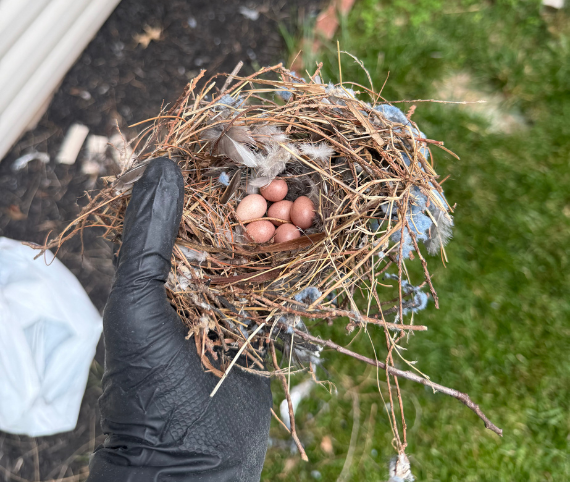
Your dryer vent exits through either a side wall or your roof. From a bird’s perspective, that opening is ideal: it’s warm, protected from wind and rain, and perfectly sized for nesting. In spring and early summer — when Northern Virginia’s trees are thick with nesting activity — birds actively scout these openings.
The communities where we see this most frequently at ABD:
In Fairfax: Neighborhoods off Route 50, Old Town Fairfax, Fair Oaks, Penderbrook, and Fairfax Station. Many homes here have original vent cap hardware from the 1980s and 1990s — no bird guard installed, or a deteriorated screen that no longer keeps wildlife out.
In Chantilly: South Riding, Franklin Farm, Sully Station, and Greenbriar. The newer townhome construction in these communities routes dryer vents through the roof, creating openings that birds discover quickly in spring.
In Centreville: Centre Ridge, Rocky Run, and Sully Station II — same roof-exit issue, same result.
In Reston and Herndon: Lake Anne, McNair Farms, Fox Mill, and Worldgate. Reston’s planned wooded communities have particularly high bird activity. We have removed active nests from dryer vents in all of these neighborhoods.
The birds most commonly found inside dryer vents in Fairfax County are European starlings, house sparrows, Carolina wrens, and occasionally mourning doves. Each species has different legal implications — which brings us to the most important thing you need to know before doing anything.
This is where almost every homeowner makes a dangerous mistake.
The Federal Migratory Bird Treaty Act (MBTA) protects most wild bird species in the United States — including many of the birds commonly found nesting in dryer vents across Northern Virginia. Under this law, it is illegal to remove, destroy, or disturb an active nest containing eggs or live young, regardless of where that nest is located. This applies to your private property. It applies inside your dryer vent. And violations can carry significant federal penalties.
Here is how the most common Fairfax and Chantilly dryer vent birds break down legally:
European Starling — NOT protected under the MBTA. Starlings are an introduced species. If you have confirmed it is a starling nest with no eggs or live young, it can be removed.
House Sparrow — NOT protected under the MBTA. Also an introduced species. Same rule applies.
Carolina Wren — PROTECTED under the MBTA. One of the most common wrens in Fairfax County. If a Carolina wren has nested in your dryer vent with active eggs or young, you cannot legally remove it until the birds have fledged and left.
Mourning Dove — PROTECTED under the MBTA. Cannot be disturbed while nesting.
Chimney Swift — PROTECTED under the MBTA. Chimney swifts are federally protected migratory birds that nest in chimneys and occasionally in exhaust vents. The Wildlife Center of Virginia has documented increasing numbers of chimney swift nesting situations throughout Fairfax County.
The practical bottom line: Unless you can confidently identify the bird as a starling or house sparrow AND the nest has no active eggs or live young — do not attempt removal yourself. Call a professional who knows Virginia wildlife law and can assess the situation correctly.
If the nest is creating a genuine fire safety hazard — a blocked dryer vent is exactly that — you may qualify for a depredation permit from the U.S. Fish and Wildlife Service, which allows legal removal of an active protected-species nest when it creates a documented safety risk. ABD can document the blockage and fire hazard with photos and help you understand your options.
A bird nest inside a dryer vent is not just an inconvenience. It is a documented fire hazard for two specific reasons:
Nesting material is highly combustible. Birds build nests from dry grass, twigs, leaves, feathers, and plant fiber — all of which are extremely flammable. Combined with the lint that has already accumulated in your vent, you have a dense mass of combustible material sitting in a duct that regularly reaches temperatures of 120–135°F when your dryer runs. The NFPA identifies blockage — including animal and bird nesting — as a specific cause factor in thousands of dryer fires annually.
Complete airflow blockage. Unlike lint buildup that gradually restricts airflow, a nest can completely block a dryer vent in days. When air can’t exit, your dryer runs hotter and longer, temperatures spike inside the duct, and the risk of ignition rises dramatically with every cycle.
We have pulled fully compacted bird nests out of dryer vents in Chantilly and Fairfax that completely filled a 4-inch duct — packed grass, feathers, lint, and debris compressed into a dense block by weeks of dryer exhaust pressing against it. Those homes had been running their dryers through that blockage, sometimes for weeks, before anyone called.
Don’t run the dryer again until the vent is cleared. If you suspect a nest, stop using the dryer until it has been professionally inspected.
Most Fairfax and Chantilly homeowners who call us about bird nests describe one or more of these:
→ Scratching or rustling sounds coming from the dryer vent area — especially in spring when birds are actively building
→ Chirping sounds that seem to come from inside the wall or near the dryer — baby birds calling for feeding
→ The dryer suddenly taking much longer — a load that dried in 45 minutes now takes 90 minutes or two full cycles
→ The exterior vent flap not opening when the dryer runs — or barely opening — because the nest is blocking it from the inside
→ A musty or organic smell from the dryer or laundry room — nesting material, droppings, and debris in the vent
→ Visible nesting material around the exterior vent opening — straw, grass, or feathers sticking out of the cap
→ The dryer shutting off mid-cycle — the thermal safety switch tripping due to blocked airflow and dangerous heat buildup
Any one of these is enough reason to stop using the dryer and call for an inspection.
We’ve handled bird nest situations in dryer vents throughout Fairfax (22030–22037), Chantilly (20151, 20152), Centreville (20120, 20121), Reston (20190–20194), and Herndon (20170, 20171). Here is exactly what happens on a typical visit:
Step 1 — Visual identification before touching anything. We check the exterior vent cap first. We look for species identification clues — feathers, nest material type, sounds — to determine whether any birds present may be federally protected. We document everything with photos before we start. If the situation involves a potentially protected species with an active nest, we explain your legal options clearly before any removal attempt.
Step 2 — Full duct inspection. We assess the complete vent path — from the dryer connection through the wall or ceiling to the exterior exit. We identify whether the nest is near the exit point, mid-run, or seated at a bend inside the duct. Location determines the approach.
Step 3 — Safe, complete nest removal. Using professional rotary brush equipment with high-powered vacuum capture, we remove the full nest and all associated debris — nesting material, feathers, droppings, compacted lint, and anything else in the duct path. All material is captured in our equipment and removed from your property.
Step 4 — Full duct cleaning. After the nest is removed, we clean the complete duct run. Droppings and nesting material leave contamination behind that should be fully cleared before you run the dryer again.
Step 5 — Bird guard installation. This is the most important prevention step. We install a durable, code-compliant bird guard cover on your exterior vent cap that allows full dryer exhaust airflow while physically blocking birds, wasps, and rodents from entering. Without a properly installed bird guard, the same thing will happen again — often within the same season.
Step 6 — Airflow test before we leave. We run the dryer briefly to confirm full airflow is restored and measure exhaust velocity at the exterior exit point. You see the before/after difference directly.
If you’re wondering how the bird got in in the first place — in most cases the answer is a standard louvered vent cap with no screen or guard.
The basic louvered plastic or metal caps installed on most Fairfax and Chantilly homes when they were built in the 1980s–2000s have flaps that open when air blows through and close when the dryer stops. Over time those flaps warp, stick open, or break. Birds quickly discover a permanently open flap and move right in.
A properly installed bird guard has a rigid metal screen over the opening that allows air to pass freely but physically blocks entry. They cost relatively little and last for years. We install them as a standard part of every dryer vent cleaning in the communities we serve throughout Fairfax County and Chantilly — because the alternative is seeing the same customers again in six months with the same problem.
Pricing depends on the vent configuration and the extent of the blockage:
| Situation | Estimated price |
|---|---|
| Standard nest removal + cleaning (wall exit, under 15 ft) | $149 – $199 |
| Nest removal + cleaning (townhome long run or roof exit) | $199 – $299 |
| Bird guard installation (added to any service) | Quoted on site |
| Full dryer vent replacement if duct is damaged | Quoted separately |
We confirm exact pricing before starting any work. No surprises.
If you’re hearing scratching, your dryer is running slow, or your exterior vent flap isn’t opening — stop using the dryer and call us. We serve Fairfax, Chantilly, Centreville, Reston, Herndon, Burke, Springfield, Annandale, Vienna, McLean, Alexandria, Arlington, and all surrounding Northern Virginia communities.
 (571) 581-9131
  info@abdaircleaning.com
  Book online here
Same-day appointments available in many cases. We are QUADCA-certified, locally based at 11166 Fairfax Blvd in Fairfax, and have 292+ verified 5-star Google reviews from Northern Virginia homeowners.
Serving Fairfax (22030, 22031, 22032, 22033, 22037) · Chantilly (20151, 20152) · Centreville (20120, 20121) · Reston (20190, 20191, 20194) · Herndon (20170, 20171) · Burke (22015) · Springfield (22150–22153) · Vienna (22180–22182) · Annandale (22003) · McLean (22101, 22102) · Great Falls (22066) · Falls Church (22041–22046) · Alexandria (22301–22315) · Arlington (22201–22209)
Is it illegal to remove a bird nest from my dryer vent in Virginia? It depends on the species. European starlings and house sparrows are not protected and can be removed. Most other species — Carolina wrens, mourning doves, chimney swifts, and many others common in Fairfax County — are protected under the Federal Migratory Bird Treaty Act. Removing an active nest with eggs or live young of a protected species without a federal permit is illegal regardless of where the nest is located. If you’re unsure of the species, call a professional before touching anything.
How do I know if I have a bird nest in my dryer vent? The most common signs are scratching or chirping sounds near the dryer vent, the dryer taking significantly longer to dry clothes, the exterior vent flap not opening properly during a cycle, or visible nesting material around the exterior vent opening. Any of these warrants stopping dryer use and calling for an inspection.
Can a bird nest in a dryer vent cause a fire? Yes — and it’s one of the more serious dryer fire risks. Bird nesting material (dry grass, twigs, feathers) is highly combustible. Combined with lint buildup and the heat generated when your dryer runs through a blocked vent, the conditions for ignition are genuine. Do not keep running the dryer if you suspect a nest.
How do I stop birds from nesting in my dryer vent again? A properly installed bird guard cover on the exterior vent cap is the only reliable prevention. Standard louvered vent caps — the default hardware on most Fairfax and Chantilly homes — offer no real barrier to birds once the flaps warp or stick. ABD installs durable bird guard covers as part of every nest removal service.
How long does bird nest removal take? Most standard nest removal and duct cleaning visits take 45–90 minutes. Townhome jobs with roof exits or long vent runs may take slightly longer. We stay until the job is completely done and airflow is confirmed before leaving.
Do you serve my neighborhood in Fairfax or Chantilly? ABD serves all of Fairfax County and the surrounding area — including Old Town Fairfax, Fair Oaks, Penderbrook, Fairfax Station, South Riding, Franklin Farm, Sully Station, Greenbriar, and all other neighborhoods in Fairfax (22030–22037) and Chantilly (20151, 20152). Same-day appointments available — call (571) 581-9131.
(571) 581-9131
info@abdaircleaning.com
Mo-Sun 8AM-8PM
Satisfaction
Located in Fairfax, ABD Air Duct and Vent Cleaning offers top-quality dryer vent, chimney air duct cleaning services to ensure a healthier and cleaner indoor environment.