
Most homeowners think a dryer vent clog means longer drying times and a slightly higher energy bill.
The reality is far more serious.
A clogged dryer vent is a fire waiting to happen — and in Virginia, dryer fires destroy homes, injure families, and kill people every single year. The most sobering part: the overwhelming majority of these fires are entirely preventable. The leading cause is not a mechanical defect, not a faulty appliance, and not bad luck.
It is failure to clean.
At ABD Air Duct & Vent Cleaning, we’re a QUADCA-certified company based in Fairfax, VA. We’ve seen what years of lint accumulation looks like inside a dryer vent — and we’ve seen the aftermath when it ignites. In this guide we’ll lay out the statistics you need to understand the real risk, explain why Northern Virginia homes are particularly vulnerable, and tell you exactly what you can do to protect your family today.
A burning smell while your dryer is running means lint inside your vent is overheating and may be moments from igniting. Turn off the dryer immediately.
 Call ABD right now: (571) 581-9131 Same-day service available across Northern Virginia.
The numbers on dryer fires come from two primary sources: the National Fire Protection Association (NFPA) and the U.S. Fire Administration (USFA), both of which analyze national fire incident data annually. The figures they report differ somewhat due to methodology — but both paint the same unmistakable picture.
According to the NFPA, U.S. fire departments responded to an estimated 15,970 home fires involving clothes dryers or washing machines each year during the study period of 2010–2014. Clothes dryers alone accounted for 92% of those fires. The annual losses from dryer fires included:
According to UL Solutions (Underwriters Laboratories), approximately 15,600 structure fires, 400 injuries, and 15 deaths occur annually as a result of dryer fires in the United States, with dryer fires accounting for over $100 million in property losses per year according to the USFA.
These numbers represent real families. Real homes. Real losses that happen year after year — in neighborhoods that look exactly like yours.
Of everything in the national data, this is the number that matters most:
Failure to clean is the leading cause of dryer fires — responsible for 1 in 3 of every dryer fire in the United States.
According to the NFPA’s detailed analysis of home dryer fires, failure to clean was the leading factor contributing to ignition, accounting for 33% of all dryer fires. These were also the most deadly: failure-to-clean fires were associated with 50% of all dryer fire deaths and 34% of all dryer fire injuries.
To put that in plain terms: the fires caused by a dirty vent are more likely to kill someone than any other type of dryer fire. And every single one of them was preventable.
The other leading causes — mechanical failure (28%), electrical malfunction (17%) — are things that can happen regardless of how careful you are. A dirty vent is a choice. It is the one cause you have complete control over.
Understanding the fire mechanism helps explain why a clogged dryer vent is so dangerous — and why it can escalate so quickly.
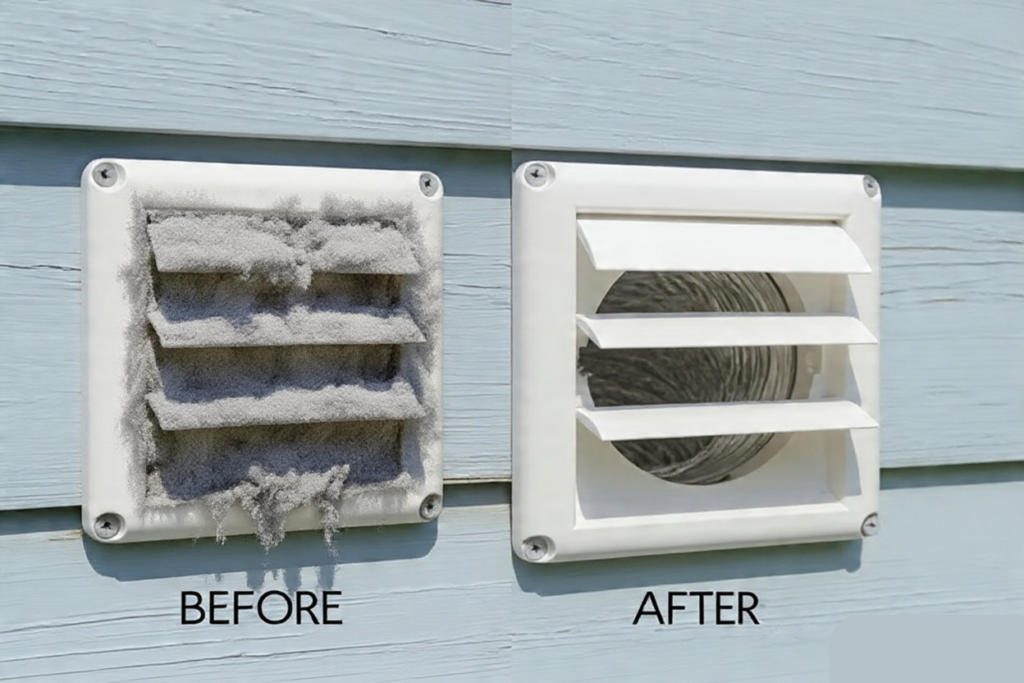
Lint is extremely flammable. The fine fibers that come off your clothing during drying — cotton, polyester, synthetic blends — are highly combustible. The lint trap catches some of it. The rest travels through your vent system and gradually coats the interior duct walls, particularly at bends, at joints, and near the exterior exit point.
Heat builds with nowhere to go. When a vent is partially or fully clogged, the hot air your dryer produces cannot escape efficiently. Your dryer’s heating element continues to cycle, temperatures inside the duct climb, and the lint coating the walls gets hotter with every minute the dryer runs.
Ignition can happen quickly and silently. Unlike a kitchen fire that you might see or smell immediately, a dryer vent fire can start inside a wall cavity — completely hidden from view. The lint ignites, the fire travels through the duct (which acts like a chimney, feeding oxygen to the flame), and by the time smoke is visible inside your home, the fire may have already spread significantly within your walls.
Townhome fires spread faster. In attached townhomes — the dominant housing type throughout Fairfax, Chantilly, Centreville, Reston, and Herndon — a dryer vent fire has shared wall access to neighboring units. A fire that starts in a duct running through a shared wall can reach a neighboring home before either family is aware a fire has started.
National statistics give you the scale of the problem. The conditions in Northern Virginia make the local risk even more acute.
The USFA’s analysis of dryer fire data specifically includes townhouses, rowhouses, and condominiums in its multifamily residential category — and notes that these properties face the same dryer fire risks as single-family homes. In Northern Virginia, where communities like Burke Centre, Sully Station, South Riding, Kingstowne, McNair Farms, and Springfield Station are almost entirely townhomes, the density of dryer vent systems is significantly higher than in suburban single-family neighborhoods.
More townhomes per acre means more dryer vents per acre. And as we’ve detailed in our guide to townhome dryer vent cleaning, townhome vents are longer, more complex, and accumulate lint faster than single-family home vents.
Thousands of townhomes built in Fairfax County, Arlington, and Alexandria between the late 1980s and early 2000s still have flexible plastic or foil accordion duct connecting their dryers to the vent system. This material is now prohibited by the Virginia Mechanical Code and recognized as a fire hazard by the NFPA. Its ridged surface traps lint far faster than smooth metal duct — and its plastic composition can itself contribute to a fire if temperatures inside the duct get high enough.
If your Northern Virginia townhome was built before 2000 and the dryer vent has never been inspected or upgraded, there is a meaningful chance you have accordion duct in your system right now.
Virginia’s Statewide Fire Prevention Code (SFPC), updated in January 2024, requires that clothes dryer exhaust systems be maintained in safe, functional working condition in accordance with manufacturer instructions and applicable building codes. A vent clogged with lint that restricts airflow or creates a fire hazard is a direct violation of this requirement. Virginia’s fire code is not a suggestion — it is an enforceable standard.
USFA data shows that dryer fires occur most frequently in the fall and winter months, with January being the peak month for incidents nationally. There are two primary reasons: people do more laundry during colder months, and dryers are used more continuously as families stay indoors. In Northern Virginia, where winters bring genuine cold from November through March, this seasonal pattern is fully applicable. If your vent hasn’t been cleaned before November, you’re entering the highest-risk months with accumulated buildup from a full year of use.
These are not inconveniences. They are your dryer’s warning system telling you that temperatures are rising toward a dangerous threshold:
Clothes take more than one full cycle to dry. Restricted airflow means heat and moisture cannot escape. Your dryer compensates by running longer and hotter.
Your dryer or laundry room feels excessively hot. Heat that cannot exit through the vent backs up into the dryer drum, the appliance exterior, and the room around it.
You smell something burning during a cycle. This is lint overheating. Turn the dryer off immediately and call a professional. Do not run another cycle.
The dryer shuts off before the cycle finishes. The thermal safety fuse — your dryer’s last line of defense — has tripped because internal temperatures reached a dangerous level.
Very weak airflow from the exterior vent. Hold your hand near the exterior vent cap while the dryer runs. You should feel a strong, steady stream of warm air. Weak or absent airflow means the vent is significantly restricted.
Lint visible around the dryer connection or at the exterior vent opening. When lint is backing up to the point of overflowing, the interior buildup is severe.
You haven’t had the vent cleaned in over a year. For most Northern Virginia homes — and especially townhomes with long vent runs — this is already past the recommended maintenance window.
Let’s translate the national statistics into what they mean for Fairfax County and the surrounding Northern Virginia area.
Virginia has approximately 3.5 million occupied housing units. With roughly 76 million housing units nationally and approximately 15,970 dryer fires per year nationally, Virginia accounts for proportionally around 700+ dryer fires per year as a state-level estimate.
Fairfax County alone has over 400,000 housing units — making it one of the most densely populated counties in the Mid-Atlantic. With high rates of townhome ownership and many older properties with never-cleaned or accordion duct systems, the local concentration of dryer fire risk is real and measurable.
These are not abstract numbers. The Fairfax County Fire and Rescue Department responds to residential structure fires year-round, and dryer-related fires are a recurring category in local fire incident reports. When you drive through your neighborhood in Burke, Chantilly, or Reston and see a fire truck parked outside a townhome — a dryer vent fire is among the most likely causes.
Here’s what makes dryer vent fires uniquely frustrating from a safety standpoint: they are among the most preventable home fires that exist.
A kitchen fire can happen despite every precaution. An electrical fire can result from wiring faults inside your walls. A dryer vent fire — specifically one caused by lint buildup — happens because a maintenance task was skipped.
Annual professional cleaning eliminates the primary cause of dryer fires for most households.
For Northern Virginia townhomes with long vent runs, roof exits, or accordion duct, cleaning every 6 to 9 months is more appropriate. The cost of professional cleaning starts at $149. The average property damage from a dryer fire exceeds $8,000 — and that number doesn’t include injuries, temporary housing, lost belongings, or the insurance rate increases that follow a claim.
The math is not complicated.
Every ABD dryer vent cleaning is a fire prevention service, not just a maintenance visit. Here’s what we do on every job:
Full inspection before we start. We check the transition hose, the full duct run, the duct material (noting accordion duct that needs replacement), and the exterior exit point. We document everything with photos.
Professional rotary brush cleaning with vacuum capture. We use commercial-grade rotary brush equipment that clears the full duct run — including long townhome runs with multiple bends and roof exits — while a high-powered vacuum captures all dislodged lint at the exit point.
Exterior vent cap inspection and bird guard installation. We check the exterior cap for damage, blockage, and animal entry. We install bird guard covers to prevent future nesting that can completely block the vent.
Accordion duct documentation. If we find unsafe flexible duct, we document it, photograph it, and explain the fire risk and replacement options. We never pressure you to decide on the spot.
Post-cleaning airflow test. We confirm measurably improved airflow at the exterior exit before we leave.
Before-and-after documentation. You receive photos of what we found and what we cleared. Transparency is a non-negotiable part of how we work.
The families who experience dryer vent fires rarely saw them coming. Their dryer was working — maybe a little slow, maybe a little warm — but nothing that seemed urgent. Until it was.
You don’t have to wait for a warning sign. Annual dryer vent cleaning is a straightforward, affordable way to eliminate the leading cause of a fire that can take everything.
ABD Air Duct & Vent Cleaning is QUADCA-certified, based in Fairfax, VA, and has 279 verified 5-star Google reviews from Northern Virginia homeowners. We tell you honestly what we find — and we give you the price before we start.
Call us now: (571) 581-9131  Email: info@abdaircleaning.com
  Book online here
Same-day appointments available across Fairfax, Chantilly, Centreville, Burke, Springfield, Annandale, Reston, Herndon, Vienna, Alexandria, Arlington, Falls Church, Woodbridge, Manassas, Great Falls, Oakton, South Riding, Lorton, and Ashburn.
How common are dryer vent fires in Virginia? Based on national NFPA data of approximately 15,970 home dryer fires per year and Virginia’s share of the national housing stock, Virginia experiences an estimated 700 or more dryer fires annually. Fairfax County, with over 400,000 housing units including a high concentration of townhomes with complex vent systems, carries a significant share of that risk.
What is the leading cause of dryer fires? Failure to clean is the single leading cause of dryer fires, responsible for approximately 33% of all dryer fires nationally according to NFPA data. These failure-to-clean fires are also the deadliest — associated with 50% of all dryer fire deaths and 34% of all dryer fire injuries. No other cause comes close.
How does lint in a dryer vent start a fire? Lint — the fine fibers shed by clothing during drying — is highly flammable. When lint accumulates inside a dryer vent and restricts airflow, the heat produced by the dryer cannot escape. Temperatures inside the vent climb with every cycle until the lint ignites. The vent duct then acts like a chimney, feeding oxygen to the flame and allowing it to travel through the duct and into wall cavities.
Are townhomes at higher risk for dryer fires? Yes. Townhomes in Northern Virginia have longer, more complex dryer vent runs than single-family homes — often traveling through multiple floors with multiple bends before exiting through a roof. Longer runs accumulate lint faster and reach dangerous blockage levels more quickly. The USFA includes townhouses and rowhouses in its multifamily residential fire data, confirming that attached housing faces the same dryer fire risks as detached homes.
When is dryer fire risk highest in Northern Virginia? USFA data shows dryer fires peak in fall and winter months, with January being the highest-risk month nationally. In Northern Virginia, this corresponds to November through February — when families use dryers more frequently and heating equipment runs harder. Cleaning before November removes a full year’s worth of buildup before the highest-risk period begins.
What are the warning signs that my dryer vent is a fire risk? Key warning signs include clothes taking more than one cycle to dry, the dryer or laundry room feeling excessively hot, a burning smell during a cycle, the dryer shutting off before completing a cycle, very weak airflow from the exterior vent, and visible lint at the dryer connection or exterior vent opening. Any of these warrants an immediate professional inspection — do not run additional cycles.
How much does dryer vent cleaning cost in Northern Virginia? ABD’s dryer vent cleaning starts at $149 for standard configurations. Townhomes with roof or attic vent exits are $249. We confirm the exact price before starting any work. Bundle discounts are available when combined with air duct cleaning on the same visit.
ABD Air Duct & Vent Cleaning is a QUADCA-certified dryer vent, air duct, and chimney cleaning company located at 11166 Fairfax Blvd, Suite 500, Fairfax, VA 22030. We serve homeowners throughout Northern Virginia and the DMV area. Call (571) 581-9131 or book online for a free estimate and same-day service.
(571) 581-9131
info@abdaircleaning.com
Mo-Sun 8AM-8PM
Satisfaction
Located in Fairfax, ABD Air Duct and Vent Cleaning offers top-quality dryer vent, chimney air duct cleaning services to ensure a healthier and cleaner indoor environment.